
Arturia Pigments has established itself as one of the most powerful and versatile software synthesizers on the market. Since its launch 7 years ago, it has continuously evolved from a promising wavetable/analog hybrid into a complete sound design platform integrating multiple synthesis engines. In this article, we explore the full history of Arturia Pigments evolution from its creation and through its major updates
Arturia, founded in 1999 in Grenoble by two french guys, first gained recognition through its precise software emulations of classic synthesizers and effects. After twenty years spent analyzing and faithfully recreating legendary instruments (Moog, Roland, Yamaha, and others), a behind-the-scenes discussion emerged within the company. Some team members wanted to leverage Arturia’s accumulated expertise to create something entirely new — not another emulation, but a major original software synthesizer built from a blank, evolvable foundation. A four-person development team was formed and given a one-year deadline to deliver the first version of the project. Led by passionate engineers such as Samuel Limier (DSP lead) and other internal talents, the focus was placed on an innovative visual interface and intuitive modulation system, making sound design both powerful and accessible. Its name evokes the rich variety of sonic colors, like an infinite palette : Pigments

The first version of Pigments, released at the end of 2018 (a dinausor !)
The first version combined two main engines — Wavetable and Virtual Analog. Nothing crazy at first but the key feature here was the highly visual modulation system with animated lines and clear routing (heritage from the late great Massive), along with dual filter slot including analog emulation of SEM and Minimoog filters, and a solid effects section. The futuristic and colored modulation matrix, dispalayed on a long horizontal bar accross the GUI, with real time animation for each was unprecedented and still unmatched !

The animated modulation matrix : ergonomic, visually pleasant, and a great learning tool
Pigments 1 stood out for its intuitive workflow and vibrant interface making complex patching accessible without sacrificing depth. It quickly gained strong acclaim in the producer community. Many praised it as a fresh alternative to Serum, with superior visual feedback and a distinctive “Arturia sound”. At the time, it was often compared favorably to competitors for its balance of power, playability and workflow. While not perfect (some users wanted more engine variety), Pigments version 1 was considered a successful debut that proved Arturia could excel beyond emulation. Nothing really revolutionary at the time in term of fonctionality, but the new workflow giving the promise of a great future
Pigments 1 Summary :
Pigments 2 is when I hopped on the train. In late 2019, just before Christmas, and after a quick brainstorming, I pulled the trigger on Pigments. Serum was also on my radar but at that time it was a non evolving v1, and Pigments Christmas sale was about half its price. Massive X despite its undeniable sonic qualities was facing a controversy following its release, and wasn’t popular among the community.
Those who had been there since version 1 received a very pleasant surprise — one that would keep repeating with every new version : a free update. Something unseen in the industry, that feels like a blessing every year. Because free and qualitative stuff are always sweet.
That is why I released 100 Free Presets for Pigments !
Feel free to download it and if you don’t own Pigments yet check for the best price at Plugin Boutique
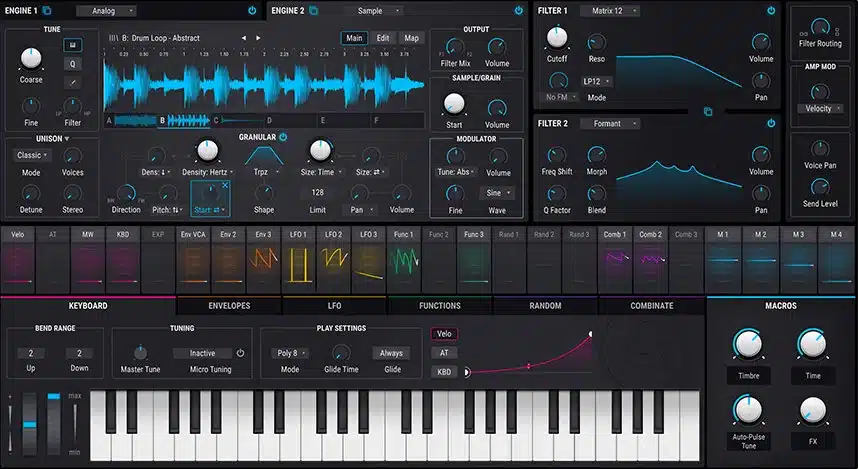
Pigments 2 introduced the Sample and Granular engine, enabling creative sample manipulation and opening the door to evolving textures and atmospheric sounds. The multi-slot system expanded the possibilities by allowing users to load and play different samples with modes such as round-robin, while the granular features proved especially useful for crafting soundscapes and complex audio mangling
Pigments 2 Summary :

The big addition with Arturia Pigments v3 was the new Additive/Harmonic synthesis with up to 512 partials, along with a third Utility engine for sub oscillators and noises. But for me the real game changer with this Pigments update was the introduction of an OTT style of multiband compressor, allowing to control both high and low levels of the signal. Useful for overall control of a sound, manage sub, bring reverb up, or to get that modern in-your-face sound

The OTT style Multiband Compressor

With Pigments 4, Arturia refined the interface and workflow. It wasn’t as huge as previous updates, but the synth was getting mature and the update solidified Pigments reputation as a synthesizer that is both deep and enjoyable for daily use. The new MS-20 filter was a nice addition with its own character (very beefy in the low end), and the Shimmer Reverb was unexpected but welcomed as it open so much sound design possibilities
Pigments 4 summary :

As the synth progresses, the update are more and more into small details and improvements. GUI updates are made on every new version and the sum of it is monumental when you look at a screenshot from v1. The external input offers the possibilty to sing or play an electric guitar directly into pigments filters and effects. The sequencer got also updated and more flexible
Pigments 5 Summary :

With the 6th version came a new engine type (again !) : The modal Engine for physical modeling. I was really interested in physical modeling type of synthesis and very excited to see the update but to be 100% honest I can’t get interesting sounds out of it. I f you have tips please explain to me. On the other hand the good surprise was the addition of a vocoder, great for traditional real time vocoding but also to experiment with as it can take input from samples as well

The new vocoder with 3 modes
Pigments 6 summary :

In the 6th update, Pigments came out with a new visually reactive Play page. I don’t use it as I’m more into sound design than performing but it is looking very nice and futuristic. The CPU optimisation may not be as impressive as a new effect but it is an essential part to keep a plugin usable, especially a beast like Pigments. Same with the envelopes rework, it is not a flashy feature but needed at the core of a good synthesizer (it’s about the sound !). A special mention for the rage filters that offer several shades of grit for 303 acid basslines, but also provide a polyphonic distortion, meaning when you play a chord it is processing each note independantly instead of crushing the input volume like a regular distorsion does !

The Rage Filter, coming with a polyphonic distortion
Pigments 7 Summary :
Version | Year | Major Additions |
|---|---|---|
| Pigments 1 | December 2018 | Wavetable + Virtual Analog + Visual Modulation |
| Pigments 2 | December 2019 | Sample & Granular engine |
| Pigments 3 | April 2021 | Additive/Harmonic engine + Utility engine |
| Pigments 4 | December 2022 | Improved UX, new filters |
| Pigments 6 | January 2025 | Modal Engine + Vocoder |
| Pigments 7 | December 2025 | Redesigned Play page + Rage / Ripple / Corroder |
From its beginnings as Arturia’s first original synthesizer to its current rich versions featuring six synthesis engines, Pigments perfectly illustrates the Grenoble team’s ability to innovate while honoring its heritage. What started as a bold bet has become a reference tool for sound designers and producers worldwide.
Thanks to yearly and free updates for owners, Pigments remains a living instrument that adapts to contemporary creative needs while retaining its unique visual and sonic identity.
Many feature requests are made every by users (including me !). What can we expect for version 8 ? In my opinion a rework of the sequencer could be a huge improvement as the flexibility is still limited. Solving the issue of exported banks weighing way too much for presets is crucial as it makes no sense to have 1Go bank size. The next big thing would also be a wavetable editor for Pigments to look the competition right in the eye 🙂
